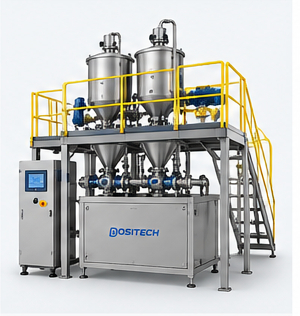
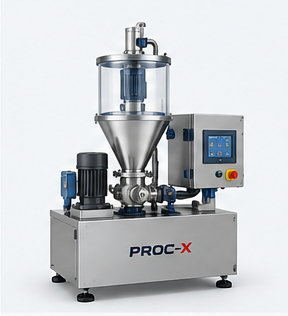
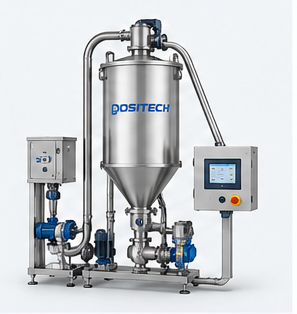
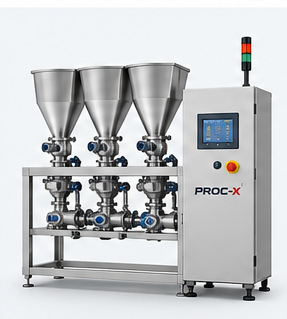
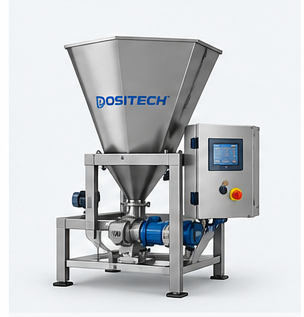
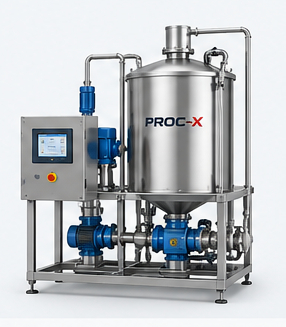
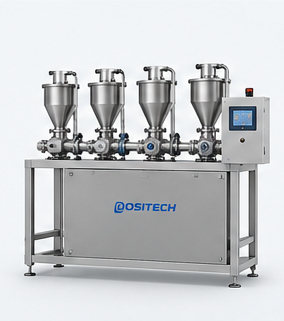
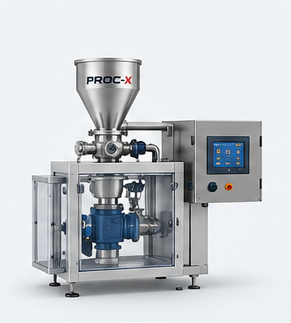
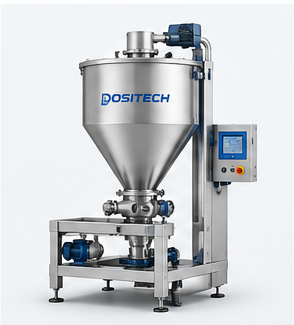
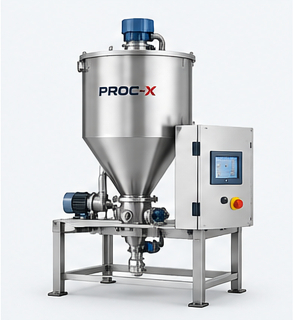
Continuous ingredient feeding and scaling systems
Eliminate Pressure Surges, Feeder Desynchronization, Vent Stuffing, and Melt Temperature Spikes Across Your Production Line
Manutrol specifies and integrates high-performance twin-screw and single-screw extrusion systems engineered to deliver uniform polymer melt quality, precise thermal control, and surge-free discharge. By optimizing screw element geometry, barrel temperature zones, loss-in-weight feeder integration, and vacuum degassing, we help processing plants across the US and Canada maximize throughput, protect shear-sensitive compounds, and maintain tight dimensional tolerances.
Mismatched feeding rates between primary polymer resin and secondary additive or color feeders cause erratic barrel filling. Gravimetric feeder drift creates non-uniform melt viscosity, resulting in off-spec compounding and dimensional variances downstream.
Unstable melt pump pressure and localized solids bridging in the feed throat cause volumetric pressure surges at the extrusion die. Surging leads to irregular extrudate profiles, wall-thickness variations, and frequent line stops.
Converting mechanical shear energy into melt enthalpy generates intense localized friction heat within high-shear screw sections. Heat-sensitive resins, biopolymers, and shear-vulnerable additives degrade, discolor, or gel without optimized barrel cooling circuits.

Inadequate vacuum venting dynamics or improper screw element configuration at degassing ports allows molten polymer to back up into vacuum lines. Entrapped moisture and volatile organic compounds (VOCs) cause internal voids, bubbles, and weak mechanical properties in the final product.
Extruding highly filled compounds containing calcium carbonate, glass fibers, titanium dioxide, or ceramic powders causes rapid physical wear on standard nitrided screws. Barrel clearance erosion degrades melt pressure capability and forces expensive rebuilds.
Polymers cling to internal barrel dead zones and die flow channels during color or formulation changes. Inefficient purge routines and complex mechanical teardowns cause extended downtime and waste expensive raw materials.
Upstream feeder precision and batch pre-mixing directly dictate downstream extrusion stability. Before recommending screw configurations—whether co-rotating twin screw, counter-rotating twin screw, or single screw—Manutrol evaluates raw feed bulk density, target melt flow index (MFI), and degassing requirements.
Because polymer behavior under extreme shear requires exact empirical verification, we conduct melt flow and torque rheometry testing at our North American facility to define exact screw speed ranges, temperature zones, and die geometries prior to equipment order.
Continuous ingredient feeding and scaling systems
Automated batch dosing system deployment
Loss-in-weight feeder integration
Custom rubber compounding dosing controls
Micro-ingredient auto-dosing lines
High-volume compounding feed synchronization
Precision automated ingredient dosing systems
Download our detailed engineering handbook to optimize melt quality, prevent thermal degradation, and synchronize feeding systems:
How to arrange conveying, kneading, and mixing elements for target shear and residence time distribution.
Eliminating rate drift and volumetric surging through integrated gravimetric control loops.
Optimizing vacuum port geometry and melt seals to prevent vent stuffing and entrapped volatiles.
Speak directly with senior process consultants who understand floor-level extrusion mechanics and compounding realities.
Direct Engineering Line & Sales Support - 555-123-4567
Direct Engineering Line & Sales Support - 416-200-3011