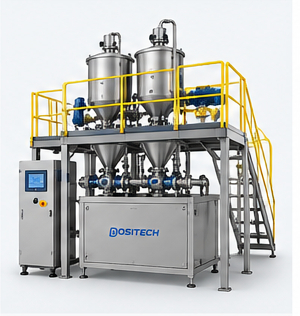
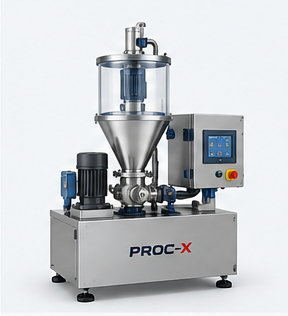
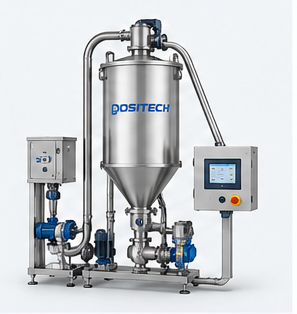
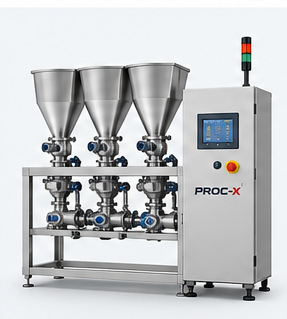
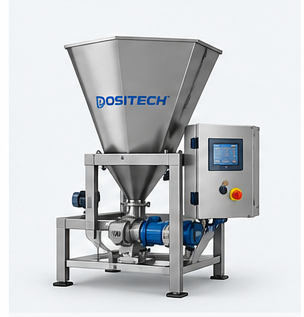
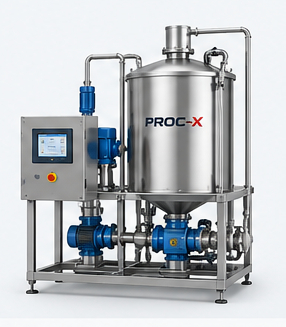
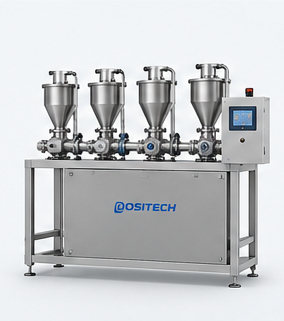
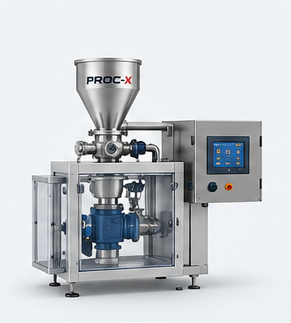
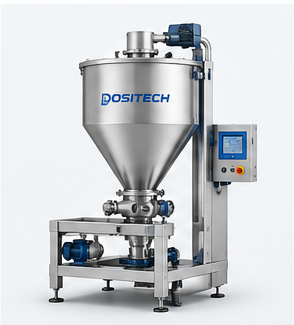
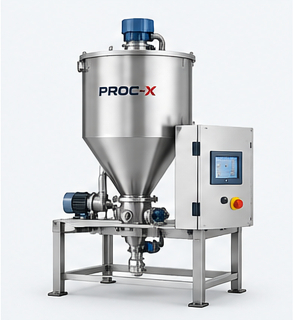
Continuous ingredient feeding and scaling systems
Achieve Exact Particle Size Distribution, Eliminate Screen Binding, Prevent Thermal Degradation, and Slash Multi-Pass Grinding Cycles Across Your Line
Manutrol specifies and integrates high-performance industrial mills and size reduction equipment engineered to deliver tight particle size distribution (PSD) without over-grinding. By optimizing rotor dynamics, screen mesh geometry, cryogenic cooling loops, and wear-resistant liners, we help processing plants across the US and Canada maximize throughput, protect heat-sensitive materials, and prevent costly line starvation.
Sticky, moist, or oily feed materials quickly blind discharge screens, causing rapid pressure build-up and drastic drops in hourly throughput. Operators are forced to halt production frequently for manual screen clearing, destroying overall equipment effectiveness (OEE).
Converting mechanical force into size reduction generates intense friction heat within the grinding chamber. Heat-sensitive polymers, waxes, resins, and active pharmaceutical ingredients (APIs) soften or melt, coating mill internals and ruining target product specs.
Conventional mills with poor speed control or mismatched rotor gap profiles create excessive ultra-fine particles ("fines"). Unwanted fines cause severe dusting, increase explosive hazards, alter slurry rheology, and reduce total usable yield.
Grinding hard minerals, silica, titanium dioxide, or glass-filled compounds severely abrades standard steel hammers and pin plates. Worn grinding media introduce unwanted iron contamination into pure batches and require constant, expensive mechanical replacements.
Fine organic, metallic, or chemical dust clouds created during dry milling represent severe deflagration and dust explosion risks. Without certified explosion containment, static grounding, and continuous pressure relief, facilities face catastrophic safety risks.

Sticky powders wedge into internal bolt threads, housing seams, and seal recesses. Inadequate Clean-In-Place (CIP) access makes thorough washdowns painfully slow, risking batch-to-batch cross-contamination during recipe changes.
From ultra-hard titanium dioxide and abrasive minerals to tacky resins, heat-sensitive actives, and fibrous biomass, we specify milling hardware tailored to exact material friability and hardness profiles. We integrate tungsten carbide inserts, ceramic liners, and cryogenic nitrogen injection to maintain peak particle integrity.
Pressure-shock resistant housings designed to contain potential internal deflagrations without structural failure.
Upstream feed sizing directly dictates downstream milling efficiency and filling precision. Before recommending mill types—whether pin mills, hammer mills, air classification mills, or conical mills—Manutrol evaluates raw feed size distribution, target final mesh size, and allowable moisture content.
Because sizing dynamics depend heavily on feed moisture and friability, we conduct empirical particle size reduction testing at our North American facility to define exact rotor speeds, air volume ratios, and screen geometries before hardware purchase.
Continuous ingredient feeding and scaling systems
Automated batch dosing system deployment
Loss-in-weight feeder integration
Custom rubber compounding dosing controls
Micro-ingredient auto-dosing lines
High-volume compounding feed synchronization
Precision automated ingredient dosing systems
How to match hammer velocity, pin spacing, and air-to-cloth ratios to target particle mesh sizes.
Mitigating thermal degradation and explosion risks when processing low-melting-point or reactive materials.
Step-by-step checklist for NFPA 652 compliance, explosion suppression systems, and air-handling isolations.
Direct Engineering Line & Sales Support - 555-123-4567
Direct Engineering Line & Sales Support - 416-200-3011